Stock code:600071


Phenix Optics Showcases Full-Chain Collaborative Innovations at 2026 CISCE
time:2026-06-22
From June 22 to 26, 2026, the 4th China International Supply Chain Expo (CISCE) was held at the China International Exhibition Center (Shunyi Hall) in Beijing.
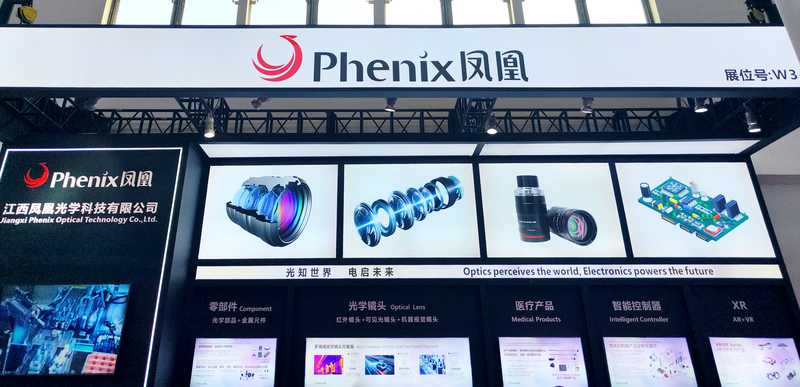
Phenix Optics made a prominent appearance at Booth W3-B02, presenting a wide range of innovative products including precision optical components, metal parts, visible/infrared lenses, machine vision/industrial lenses, medical endoscopes, and intelligent controllers -- demonstrating its full-chain collaborative capabilities from core components to intelligent systems.
Precision Optical Components & Metal Parts:
Strengthening the Industry Foundation
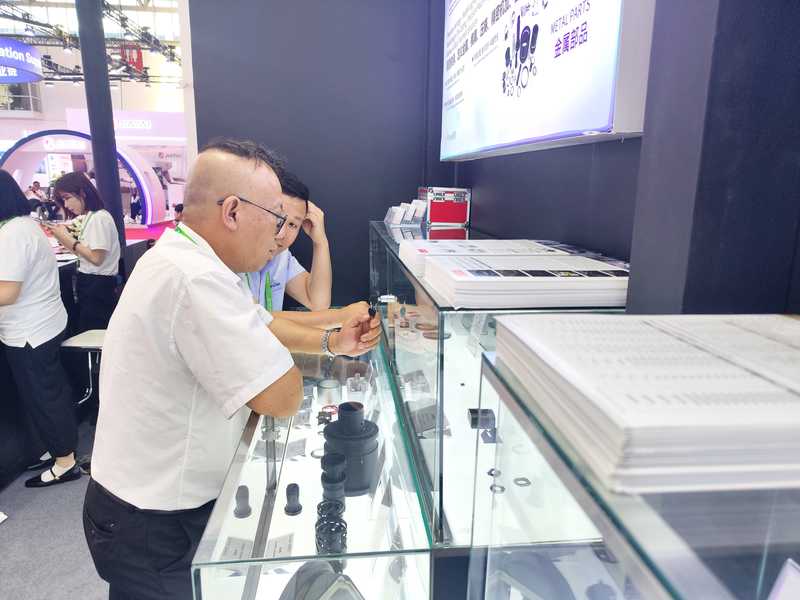
In optical components, Phenix showcased a full product portfolio including spherical lenses, flat lenses, aspherical lenses, cylindrical lenses, and prisms. The ultra-compact glass aspherical lens measures just φ2mm in diameter, with minimum processing capability down to φ1.2mm, supporting 5-element lens cementing and achieving surface accuracy PV≤0.5μm. Medical-grade prism products feature triple-prism bonding and grooving processes, with air-spaced cementing accuracy up to 0.005mm. Flat mirrors achieve reflectance≥95% in the 890~950nm band with diffuse reflectance≤0.5% and surface accuracy PV of 0.5μm. Cylindrical lenses offer decentering accuracy within 3′and support single-sided, double-sided, and cemented cylindrical configurations.
In metal components, lens barrels cover diameters from 6mm to 240mm with coaxiality accuracy controlled within 0.006~0.015mm. Cam curve tubes achieve groove width control within 0.02mm and can machine up to 12 or more curved grooves. Mounts achieve surface roughness Ra0.4. Die casting and precision machining capabilities range from 160 to 500 tons, capable of producing complex frames, housings, and high-strength automotive components. The ultra-low reflectivity oxidized metal structural parts employ a patented iron-based oxidation process, achieving diffuse reflectance<5% and specular reflectance <1% in the 905~950nm near-infrared band, with UV resistance exceeding 1,200 hours without discoloration -- offering superior stability over conventional micro-arc oxidation. These are widely used in automotive LiDAR lenses and projection systems.
Optical Lens Business:
Covering Intelligent Driving, Security, Infrared Thermography, and Machine Vision
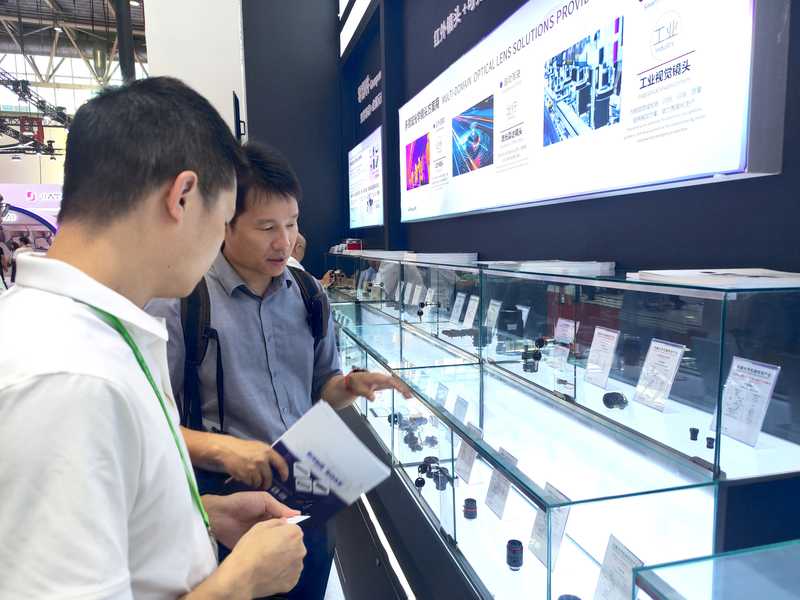
LiDAR lenses cover applications including automotive main radar, blind-spot radar, robotics, spatial mapping, and consumer-grade lawn mowers. The products feature automotive-grade reliability with localized main and auxiliary materials, and the company possesses full-chain mass production capabilities from design and precision processing to assembly. Automotive projection lenses provide optical solutions for immersive in-car visual experiences and intelligent headlight applications.
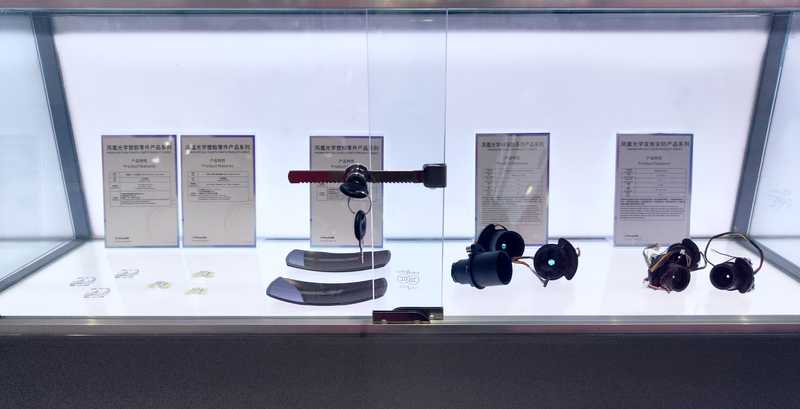
In security surveillance lenses, zoom lenses cover the 2.8~12mm focal range, support 2MP to 5MP resolution, deliver precise focusing across all temperature ranges, and feature excellent stray light suppression. 4K fixed-focal lenses adopt a glass-plastic hybrid structure with low-dispersion coating technology, achieving athermalized precise focusing from -30°C to 70°C with superior distortion control -- covering smart transportation, building security, and industrial monitoring applications. ITS road surveillance lenses support flexible multi-focal switching with low-light and infrared co-focus capabilities, delivering clear images around the clock. Plastic optical components cover automotive, security, and projection applications, with processing diameters from φ3mm to φ100mm and PV accuracy up to 0.4μm±0.2μm, waterproof coating contact angle >110°, and thermal shock resistance of up to 1,000 cycles. LiDAR window lenses support active heating functionality and 940nm–1550nm band customization with curved surface capability.
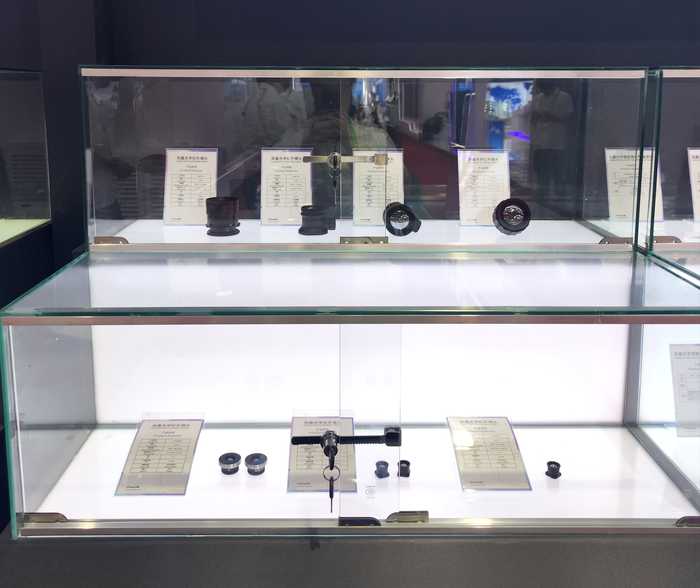
In infrared thermal imaging lenses, products support a wide range of detector specifications from 384×288 to 640×512, with focal lengths covering 6.4mm to 50mm. All products feature optical athermalization design, maintaining stable imaging across the full temperature range of -40°C to +80°C without the need for refocusing. Short-focal products are suitable for portable applications such as drones and handheld observation, while long-focal products address long-range detection needs including forest fire prevention and border/coastal surveillance. The lenses incorporate chalcogenide glass and aspheric diffractive surface processing, featuring large apertures (F1.0~F1.1), high transmittance, and low distortion -- widely used in security monitoring, industrial temperature measurement, outdoor night vision, and unmanned inspections.
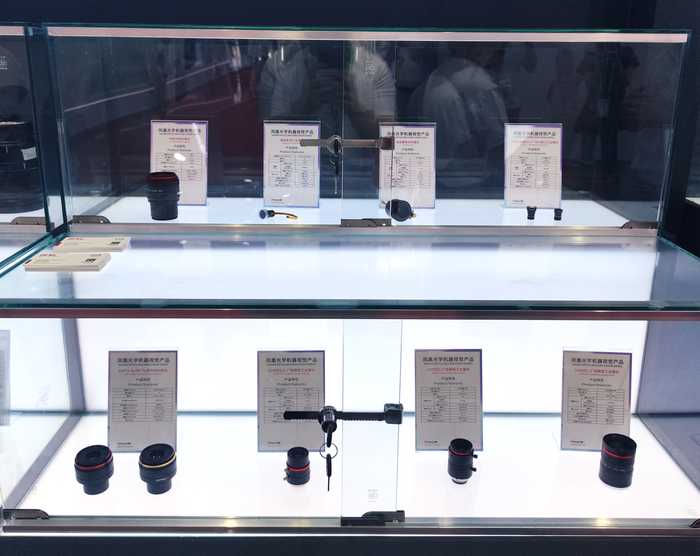
In machine vision, the company exhibited 25MP 1.2", 10MP 2/3", and 12MP 1/1.7" low-distortion industrial lenses, 16K and 4K line-scan lenses, liquid lenses, and motorized focus lenses. The 25MP 1.2" industrial lens covers focal lengths from 12–50mm with maximum aperture F2.4, distortion ≤ ±0.1%, and compatibility with 1" to 1.2" cameras -- suitable for high-precision inspection, positioning, and measurement. The 16K line-scan lens series achieves a maximum image circle of Φ60mm with optical distortion controlled between -0.04% and 0.16%, empowering industrial automation with smarter "eyes."
Medical Endoscopes:
Safeguarding Life and Health
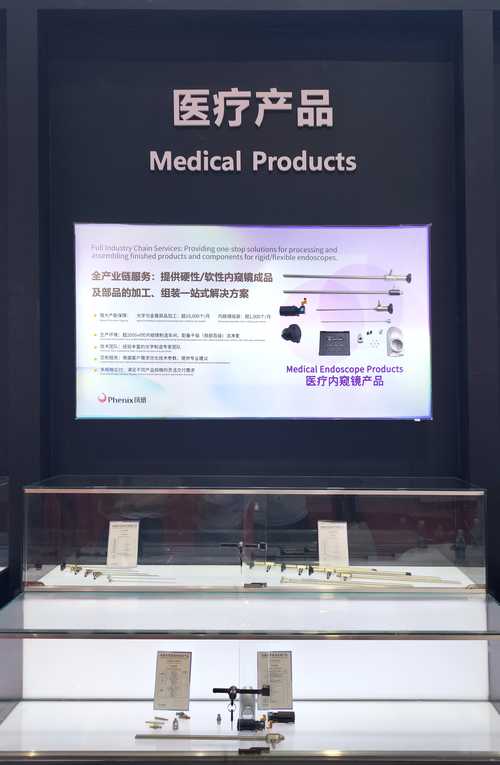
The 10mm laparoscope supports 4K UHD resolution with 0°/30°direction of view options, 330mm working length (customizable), 3~200mm depth of field, and color rendering index >92%. Featuring brazed sapphire windows combined with laser marking and welding, it can withstand over 500 autoclave sterilization cycles and low-temperature plasma sterilization. The 4mm sinus endoscope supports HD resolution with 175mm working length (customizable), 3~100mm depth of field, and color rendering index >90%. Both products achieve a monthly production capacity of 1,000 units. Also on display were core components including objective lens assemblies (supporting 5-element cementing), rod lenses, coated prisms (angle accuracy ±2′, surface accuracy λ/4), and brazed sapphire windows -- comprehensively addressing the core requirements of medical endoscopy.
Intelligent Controllers:
Driving a Smart Future
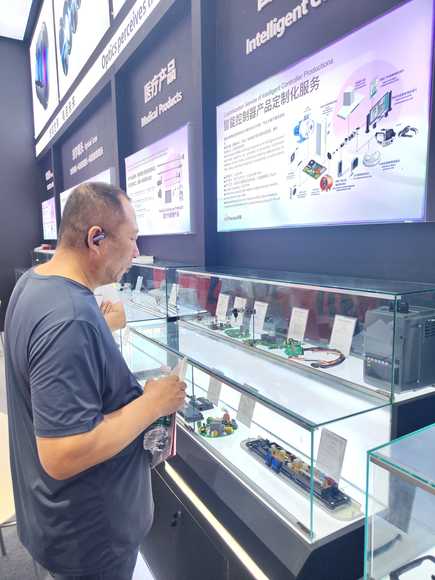
Phenix featured ten controller products including inverter range hood power boards, washing machine controllers, energy storage BMS, motor controllers, booster pump driver boards, EC fan electrolytic-capacitor-free driver boards, canned-motor pump driver boards, AC/DC auto-adaptive solar deep-well pump driver boards, general-purpose VFDs, and liquid cooling pumps. The EC fan electrolytic-capacitor-free driver board employs sensorless FOC vector control technology with power coverage from 0.75~5.5kW, and its all-film capacitor solution ensures an ultra-long service life. The canned-motor pump driver board covers 25~350W with support for flow-estimation feedback, PWM, and preset curve control modes. The 48V liquid cooling pump driver controller features sensorless FOC sinusoidal drive with speed control accuracy of ±0.5%, applied in AI computing cold-plate liquid cooling and immersion cooling thermal management systems.
During the exhibition, the Phenix Optics booth attracted numerous domestic and international customers for in-depth discussions, with the technical team engaging on topics including optical design, precision manufacturing, and supply chain collaboration -- yielding positive cooperation interest. As an optical enterprise with over six decades of history, Phenix Optics will continue to drive innovation and work with global partners to explore new frontiers in optoelectronic technology.